In today’s competitive job landscape, cracking interviews—especially for FAANG or Fortune 500 companies—requires much more than just technical knowledge. You need real-time interview exposure to stay confident under pressure, understand behavioral cues, and refine your communication style.
That’s where AI interview assistants are changing the game. 🚀
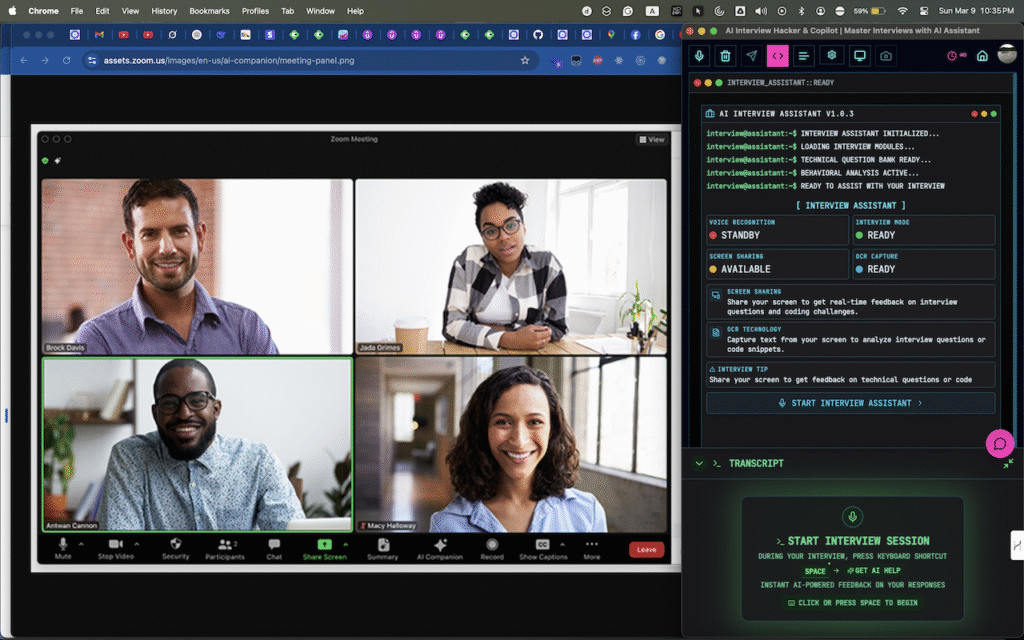
These tools don’t just ask random questions—they simulate real interview environments, helping you build confidence and readiness as if you were sitting across a real hiring manager.
🎯 Why Real-Time Interview Simulation Matters
Practicing with static question lists or traditional mock interviews isn’t enough. Real interviews involve:
- Dynamic questioning
- Time-bound responses
- Tone and expression analysis
- Behavioral evaluation
AI interview assistants replicate these exact conditions using voice recognition, natural language processing (NLP), and real-time feedback systems, giving candidates the most realistic prep possible.
🧠 How AI Interview Assistants Create Real-Time Scenarios
Here’s how modern AI interview assistants simulate real interviews in detail:
1. Personalized Interview Contexts
AI assistants analyze your target role, company, and domain to create custom interview environments.
For example:
- Applying for a Software Engineer role at Amazon? Expect coding and behavioral rounds modeled on Amazon’s Leadership Principles.
- Targeting a Product Manager role at Google? Get product design and strategy questions tailored to Google’s interview framework.
2. Real-Time Questioning
Instead of pre-fed scripts, these tools adapt dynamically—just like real interviewers.
If you answer a question well, the AI might:
- Dig deeper with follow-up questions
- Challenge your assumptions
- Ask scenario-based variations
This continuous loop trains your cognitive flexibility and spontaneous thinking—crucial traits in real interviews.
3. Voice and Facial Recognition for Authentic Feedback
Top AI assistants use speech tone detection and facial emotion tracking to assess:
- Confidence level
- Eye contact
- Vocal clarity
- Hesitation or filler words
Some even score your body language and energy level, just like human recruiters.
4. Role-Based Mock Panels
AI systems can mimic entire panel interviews—where you face multiple virtual interviewers. Each “interviewer” focuses on a different aspect:
- One tests technical competence
- Another judges teamwork and leadership
- Another evaluates creativity and problem-solving
It’s a near-perfect simulation of top-tier interview processes.
5. Behavioral Analysis and STAR Framework Integration
AI interview assistants often integrate behavioral models like the STAR (Situation, Task, Action, Result) framework.
They analyze your storytelling patterns and give feedback such as:
“Your response lacks measurable outcomes.”
“Consider detailing your specific action steps.”
Over time, this fine-tunes your ability to structure responses precisely and persuasively.
⚙️ Examples of AI Assistants Creating Real Interview Scenarios
| AI Interview Assistant | Core Feature | What Makes It Realistic |
|---|---|---|
| Interview Sidekick | AI-powered mock interviews | Adaptive questioning, behavioral evaluation, and company-specific feedback |
| HireVue | Video-based interview simulation | Uses facial and tone analysis to replicate recruiter interactions |
| VMock | Resume + interview readiness assistant | Provides AI-driven verbal and nonverbal feedback |
| Rezi AI Coach | Real-time answer practice | Evaluates communication clarity and confidence |
| Interview Warmup (Google) | Voice-based Q&A practice | Focused feedback on word choice, speaking pace, and key topic coverage |
💡 The Edge of Real-Time AI Practice Over Traditional Mock Interviews
| Aspect | Traditional Mock Interviews | AI Interview Assistants |
|---|---|---|
| Feedback Quality | Human, subjective | Instant, data-driven, and consistent |
| Scalability | Limited (per session) | Unlimited sessions and variations |
| Adaptability | Static question set | Dynamic, role-based questioning |
| Convenience | Requires scheduling | 24/7 accessibility |
| Realism | Human tone but limited simulation | Multimodal (voice, video, expression) realism |
🧩 Practical Use Case: Real-Time Prep for a Google Product Manager Interview
Imagine you’re preparing for a Google PM interview.
You open Interview Sidekick, set your target company and role, and instantly receive:
- Realistic product design and behavioral questions
- Follow-ups when you sound unsure
- Feedback on speech rate, filler words, and confidence
After 3–4 rounds, you not only answer better but also think like a PM—structured, confident, and data-oriented.
🚀 Final Thoughts
AI interview assistants have made real-time interview practice accessible to everyone, no matter where you live or what your schedule looks like.
By simulating high-pressure environments and delivering actionable feedback, they help you:
- Build genuine confidence
- Think on your feet
- Refine communication and body language
When used consistently, AI tools transform your prep from casual practice to real performance training—bridging the gap between knowing and acing.
🗣️ TL;DR
AI interview assistants use NLP, facial analysis, and adaptive questioning to replicate real interview environments. They provide instant, objective feedback, helping you practice anytime, anywhere, and with the same intensity as a live interview.